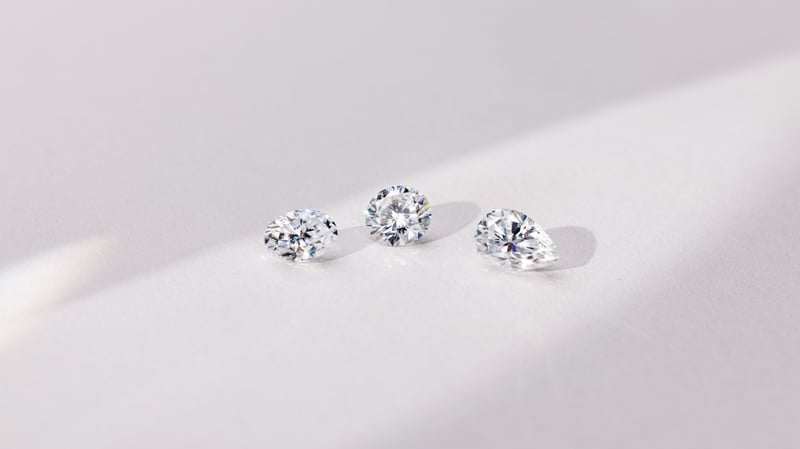
Although it closely resembles a diamond, a “moissanite diamond” doesn’t actually exist. Like emeralds or sapphires, moissanite is a genuine gemstone in its own right, with distinct characteristics and natural brilliance. Its exceptional sparkle, affordability, and ethical appeal have made it an increasingly popular choice for those seeking something different from tradition—or simply drawn to its unique shine.
Moissanite Is a Unique Gemstone in Its Own Right
With a discovery story that’s truly otherworldly, moissanite was first found in 1893 by French scientist Henry Moissan inside a meteor crater in Arizona. At first, he believed he had uncovered diamonds, but further research revealed the tiny crystals were actually silicon carbide—an entirely new gemstone that would later bear his name: moissanite.
Naturally occurring moissanite is incredibly rare, but thanks to modern technology, it can now be expertly created in laboratory settings. Being lab grown makes moissanite both more affordable and environmentally responsible. With no mining involved, its origin is fully traceable and free from many of the ethical and environmental concerns linked to traditional gemstone extraction.
Moissanite Has Distinct Physical Properties
While moissanite may resemble a diamond at first glance, it is a distinct gemstone with its own set of physical characteristics. Differences in chemical composition, hardness, clarity, colour, and brilliance clearly set moissanite apart from diamonds and other white gemstones.
Chemical Structure
Unlike diamonds, which are composed of carbon, moissanite is formed from silicon carbide. Because naturally occurring moissanite is exceptionally rare, the moissanite used in modern jewellery is grown in carefully controlled laboratory conditions. It is created using the Physical Vapour Transport (PVT) process—an advanced technique where silicon carbide is heated in a vacuum until it sublimates into vapour. This vapour then travels to a cooler area of the chamber, where it slowly deposits onto a seed crystal, gradually forming a beautifully brilliant moissanite gemstone.
How Tough is Moissanite Compared to Diamond
A gemstone’s hardness is measured on the Mohs scale, which ranges from 1 (the softest) to 10 (the hardest). Moissanite ranks an impressive 9.25 on this scale, making it second only to diamond, which scores a perfect 10. This exceptional hardness means moissanite is highly durable and well suited to everyday wear, retaining its brilliance and appearance for a lifetime without fading or dulling.
Moissanite’s Clarity
Diamonds are traditionally assessed using the four C’s: cut, clarity, colour, and carat. Because moissanite is lab grown, its cut and clarity are highly consistent, meaning the stones are almost always near-flawless, with only tiny inclusions visible under magnification. Moissanite is also typically graded as colourless, unless a coloured option is chosen. While both diamonds and moissanite appear white, the key visual difference lies in how moissanite interacts with light, giving it a distinctive sparkle driven by its unique optical properties.
How Brilliant is Moissanite vs Diamond (Brilliance and Fire)
Moissanite has a higher refractive index than diamond, which means it bends light more intensely as it passes through the stone. This results in increased brilliance and a greater display of colourful flashes, known as fire. In natural sunlight, moissanite sparkles vividly and can even produce a rainbow-like, “disco-ball” effect. Compared to the softer blue, grey, and white reflections of a diamond, moissanite’s sparkle is more vibrant—often the very trait that makes it so captivating.
Because moissanite is lab grown, it is significantly more affordable than mined diamonds and even less expensive than lab-grown diamonds. While diamonds can vary widely in quality and price based on the four C’s, moissanite shows very little variation in cut, clarity, or colour and is primarily priced by size. This allows you to choose the look and presence you’ve always wanted without compromise. Although moissanite shares some visual similarities with diamonds, it is a gemstone entirely its own—formed from extraordinary origins and prized for a brilliance that can even surpass that of a diamond. With moissanite, you never have to trade quality for value, and you can trust that its sparkle will last a lifetime.